

Your cart
The Pig War: The Time the US and Britain Almost Went to War Over a Pig
 TRUE STORY
Most wars start with an assassination, an invasion, or a really bad treaty. This one started with potatoes.
A Border Nobody Finished Drawing
In 1846, the United States and Britain signed the Treaty of Oregon, setting their border along the 49th parallel. Neat, tidy, done. Except the treaty said the line ran down “the middle of the channel” between the mainland and Vancouver Island, and there were two channels. Americans pointed to Haro Strait. The British pointed to Rosario Strait. Sitting right between them were the San Juan Islands, which both nations now considered theirs.
By the late 1850s, San Juan Island was home to a Hudson’s Bay Company sheep farm and a growing cluster of American settlers, many of them gold-seekers who’d come back from the Fraser River without much gold. It was a shared island with two sets of laws and zero agreement on which set counted. All it needed was a spark.
The spark had four legs and a snout.
The Shot Heard Round the Potato Patch
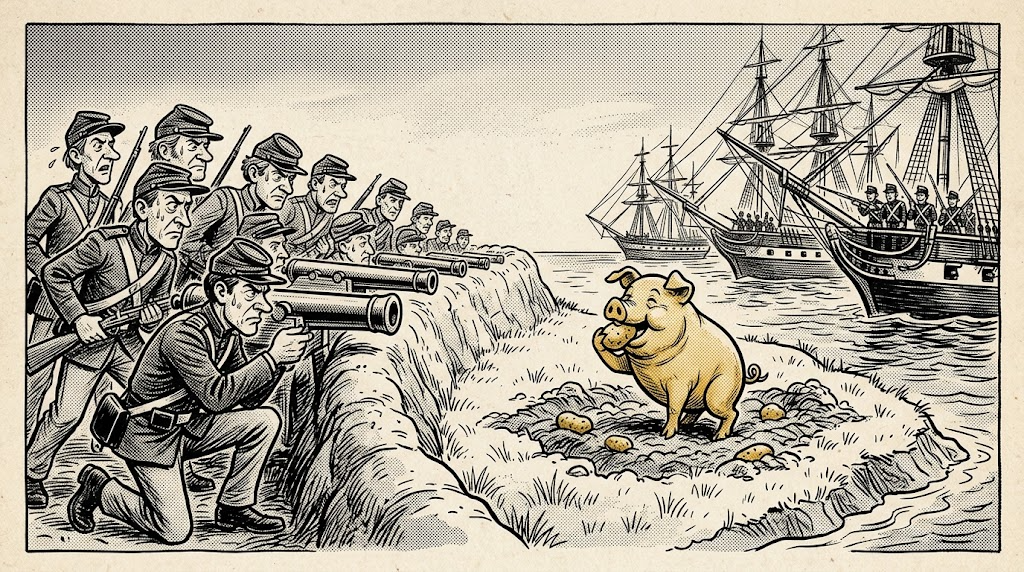
On June 15, 1859, an American settler named Lyman Cutlar found a pig rooting through his garden, helping itself to his potatoes. By most accounts this wasn’t the pig’s first visit. Cutlar shot it.
The pig belonged to Charles Griffin, who ran the Hudson’s Bay Company farm. Cutlar offered $10 to cover the loss. Griffin reportedly wanted far more (some accounts say $100), and British authorities threatened to arrest Cutlar. The American settlers, now extremely worried about being evicted, did what any reasonable community would do over a dead pig: they asked the US Army for protection.
Escalation, Hold the Bacon
The regional US commander, Brigadier General William S. Harney, was not a big fan of the British. He sent Captain George E. Pickett with a company of roughly 60-odd soldiers, who landed on July 27, 1859. (Yes, that Pickett, the one later famous for a charge at Gettysburg.)
The British answered with warships. American reinforcements kept arriving. By the end of August, according to the National Park Service, the US had 461 men dug in behind an earthen redoubt with 14 cannons. Offshore, the British had assembled a force that HistoryLink puts at five warships, 167 guns and about 2,140 troops. Other accounts give smaller British numbers, but every version is wildly out of proportion to one pig.
Two global powers were now staring at each other down gun barrels over pork.
The Admiral Who Said No
Fortunately, the man in charge of Britain’s Pacific naval forces had some perspective. When Rear Admiral Robert Lambert Baynes arrived, he flatly declined to start shooting. He summed up his reasoning perfectly:
He would not “involve two great nations in a war over a squabble about a pig.” — Rear Adm. Robert L. Baynes, as quoted by the National Park Service
Meanwhile, Washington was alarmed to learn that Harney had nearly started a war on his own initiative. President James Buchanan sent General Winfield Scott to calm things down. Scott and the colonial governor, James Douglas, agreed that each side would keep only a token force on the island until diplomats sorted it out. Harney was reassigned.
Twelve Years of Awkward Roommates
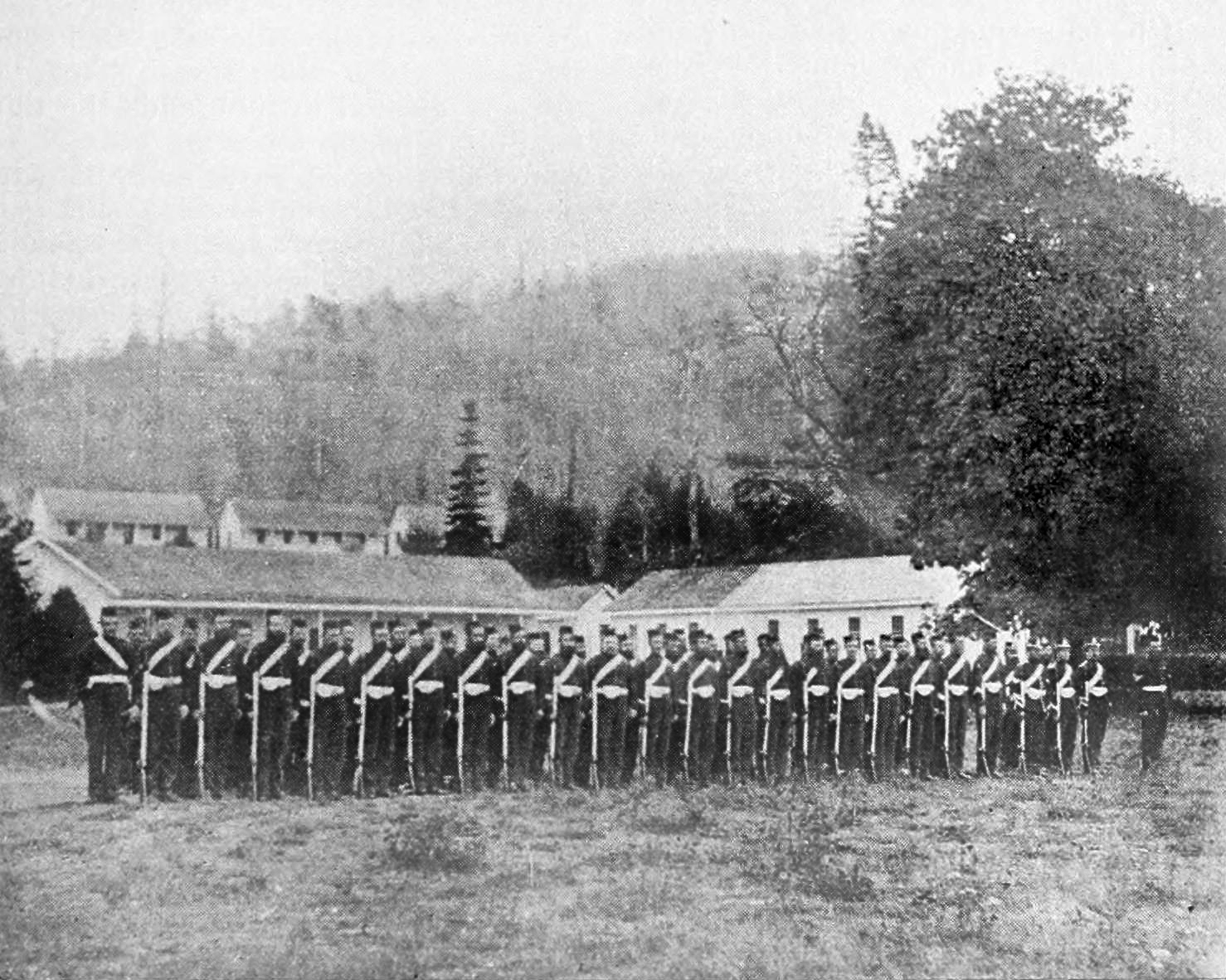
So began one of history’s politest military occupations. American troops held the south end of the island. British Royal Marines set up English Camp on the north end in March 1860. They stayed there for 12 years. The National Park Service notes that officers from both camps socialized, sharing whisky and cigars. This was a “war” with dinner parties.
Finally, the 1871 Treaty of Washington handed the question to a neutral referee: Kaiser Wilhelm I of Germany. A three-man commission studied the matter for nearly a year in Geneva, and on October 21, 1872, the decision came down. The border would run through Haro Strait, and the San Juan Islands belonged to the United States. The Royal Marines packed up and left on November 25, 1872.
The Final Body Count
Two empires. Hundreds of soldiers. Dozens of cannons. A fleet of warships. Twelve years of standoff. A German emperor called in to referee.
Total casualties: one pig.
Sources
More true stories
 True Stories · Nov 2, 2026The Herring Fart Submarines: How Sweden Hunted Soviet Subs That Turned Out to Be FishFor years Sweden hunted mystery Soviet submarines. A prime minister even wrote to Yeltsin. The culprit? Herring, passing gas. A true Cold War comedy.
 True Stories · Nov 2, 2026The Bat Bomb: The WWII Plan to Firebomb Japan With Bats (That Torched a US Air Base Instead)A dentist convinced the US military to strap firebombs to bats. In testing, the bats escaped and set an American air base ablaze. The true Bat Bomb story.