

Your cart
The Bat Bomb: The WWII Plan to Firebomb Japan With Bats (That Torched a US Air Base Instead)
 TRUE STORY
Every great military innovation begins with a visionary. This one began with a dentist on vacation.
A Dentist Has an Idea
Lytle S. Adams was a dental surgeon from Irwin, Pennsylvania, who had been awed by the swarms of bats at Carlsbad Caverns in New Mexico. Then came Pearl Harbor. In January 1942, a little over a month after the attack, Adams sent the White House a proposal: capture millions of bats, attach tiny firebombs to them, and release them over Japan.
His logic wasn’t entirely crazy. Bats roost in dark, hidden spots like attics and eaves. Many Japanese cities were built largely of wood. Release enough bats at dawn, let them tuck themselves into buildings, and you could start thousands of fires at once. Adams pictured fires breaking out across a circle 40 miles wide for every bomb dropped.
The idea reached President Franklin D. Roosevelt, who forwarded it to the head of the intelligence service with a note that has to be one of the great presidential endorsements of all time:
“This man is not a nut.” — Franklin D. Roosevelt, as quoted by Wikipedia
FDR did add that it sounded like a “perfectly wild idea.” But he said it was worth a look, and so the US military went into the bat business.
Building a Better Bat
Researchers tested several species before picking the Mexican free-tailed bat, a tiny creature weighing about half an ounce that could carry a payload a little heavier than itself. Harvard chemist Louis Fieser, the inventor of napalm, helped design miniature incendiaries for them.
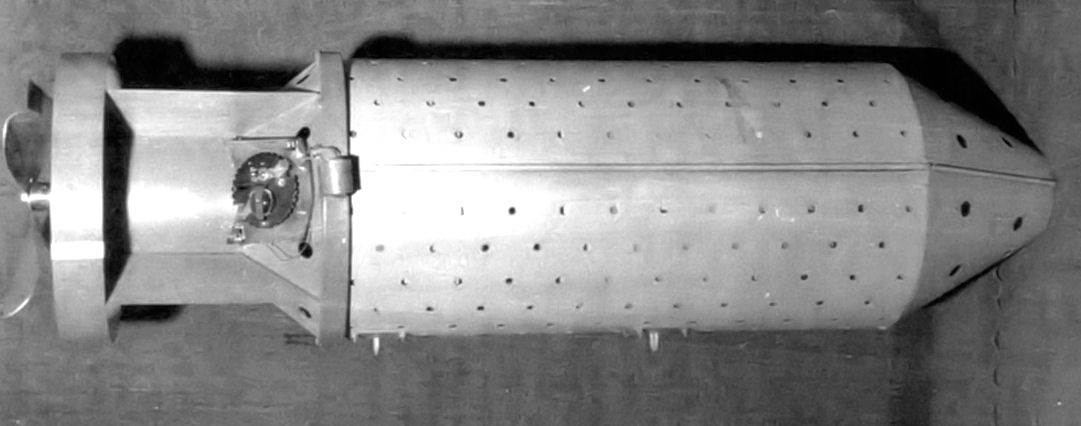
The plan was to cool the bats into hibernation, pack them into bomb-shaped carriers holding about a thousand bats each, and drop them from planes. The carriers would open in mid-air, the bats would warm up, wake, and fly off to roost. The timed fuses would handle the rest.
It was clever. It was creepy. It was also about to go spectacularly wrong.
The Incident
In 1943, testing moved to the Carlsbad Army Airfield Auxiliary Air Base in New Mexico. Wikipedia dates the mishap to May 15, 1943; other accounts give only the year. Some bats armed with live incendiaries were accidentally set loose.
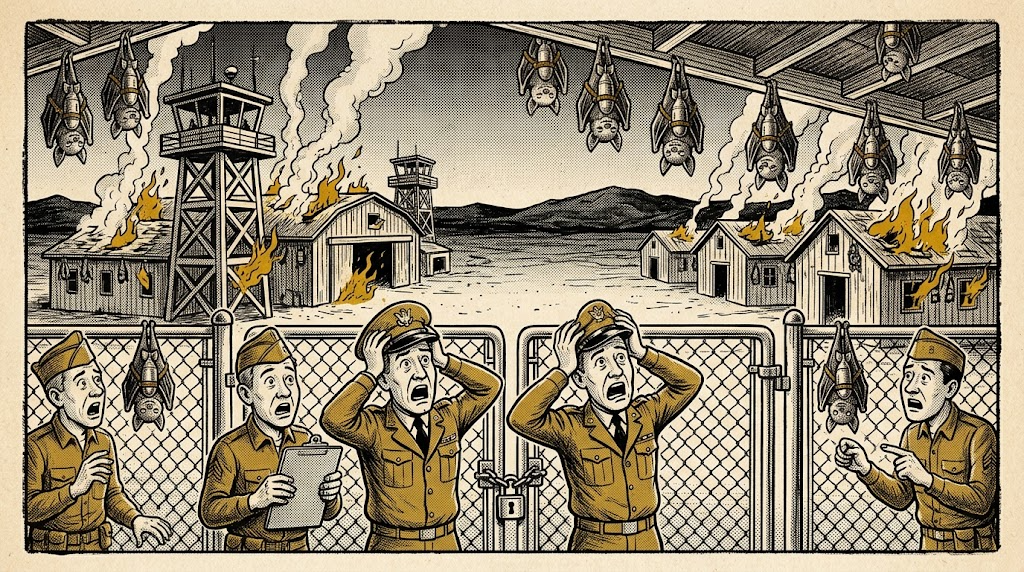
And bats, being bats, did exactly what the whole program was designed to make them do: they found cozy places to roost. Unfortunately, those cozy places were on the US military’s own base. According to the National Park Service, the bats settled into the control tower, hangars, offices and barracks, and most of the facilities burned. Wikipedia’s account has some roosting under a fuel tank. Because the project was classified, base personnel couldn’t simply rush in. Many could only watch from behind locked gates.
In fairness, it was a very convincing demonstration that the concept worked.
Project X-Ray Takes Flight (Then Doesn’t)
Undeterred, the military kept going. The Navy took over in August 1943 and renamed the effort Project X-Ray, then passed it to the Marine Corps that December. Tests on a mock Japanese village at Dugway Proving Ground in Utah went well. One estimate held that a load of bat bombs could start thousands of fires, versus a few hundred for a conventional bomb load.
But in 1944, Fleet Admiral Ernest J. King cancelled the program after learning it probably wouldn’t be combat-ready until mid-1945. Development was slow, and it was being overtaken by another secret program you may have heard of, the atomic bomb. By then, roughly $2 million had been spent on bat-based warfare.
The Legacy
The Bat Bomb never saw combat. It never burned a single enemy building. Its one and only real-world success story is the time it set fire to an American air base.
So the bats did win a battle in World War II. It just happened to be against the US Army.
Sources
More true stories
 True Stories · Nov 2, 2026The Herring Fart Submarines: How Sweden Hunted Soviet Subs That Turned Out to Be FishFor years Sweden hunted mystery Soviet submarines. A prime minister even wrote to Yeltsin. The culprit? Herring, passing gas. A true Cold War comedy.
 True Stories · Nov 2, 2026The Pig War: The Time the US and Britain Almost Went to War Over a PigIn 1859 an American farmer shot a British-owned pig. Troops and warships followed. The true story of the Pig War, where the only casualty was the pig.